


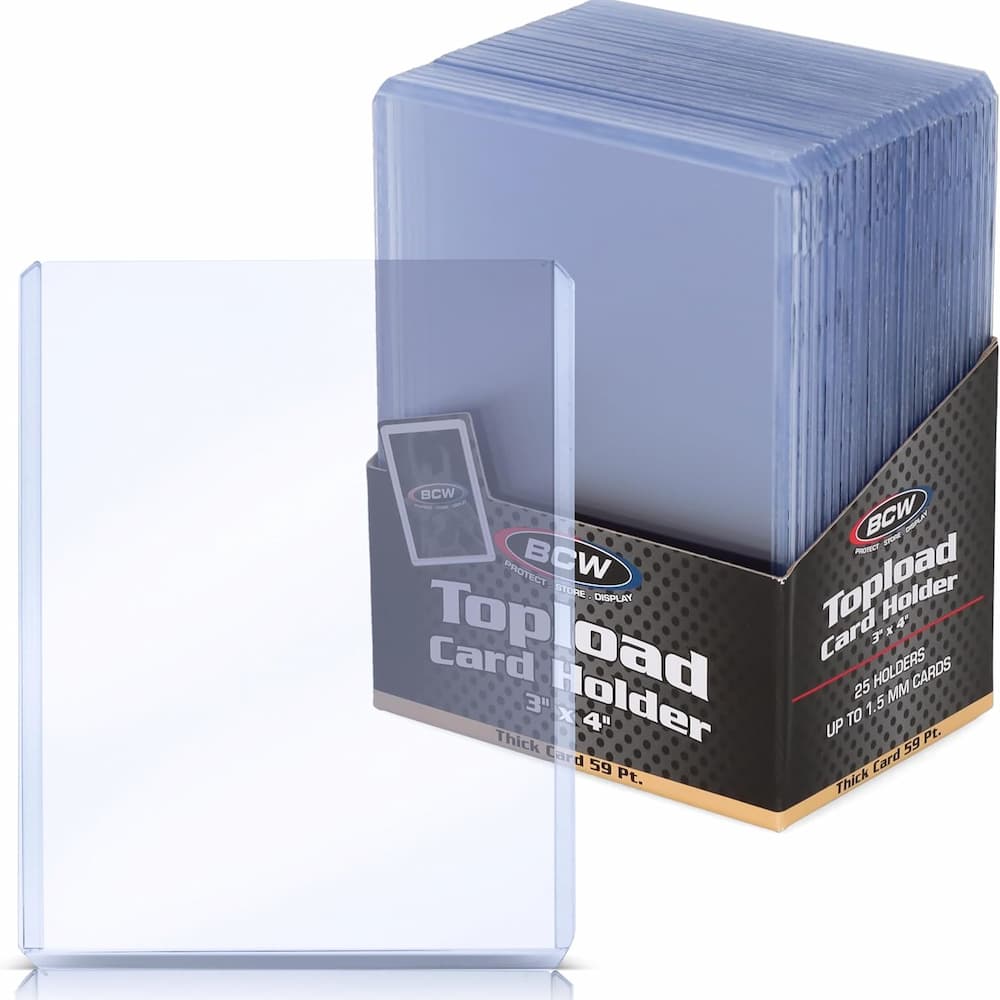

Choose a toploader for a thick patch or relic card by measuring the card’s thickness, checking the holder’s interior width and height, and allowing room for the sleeve you intend to use. “Patch card” is not a size: different cards can need different holders, even within the same collection.
What does the point number mean?
A point is one thousandth of an inch: 1,000 points equal 1 inch, or 25.4 mm. The point rating describes thickness; it does not tell you the holder’s width or height.
That distinction matters when shopping for a “3 × 4” toploader. Those are outside dimensions. A card can be thin enough for a holder and still be too wide or too tall for its interior.

How to measure a patch or relic card
A digital caliper can help you estimate thickness more closely than an ordinary ruler. Work on a clean surface, zero the caliper, and bring its jaws gently up to the card’s edge without squeezing. Avoid contacting a raised patch or delicate surface; stop if you cannot take a measurement without putting pressure on the card.
- Check the thickest area. A patch or relic card may not have the same thickness throughout. Do not assume every card in a set uses one holder size.
- Convert the measurement. Multiply inches by 1,000, or divide millimeters by 0.0254, to estimate points. For example, 2.5 mm is about 98 points.
- Allow room for the sleeve. A bare-card measurement is a starting point. A 98-point card still needs extra room for its sleeve; a nominal holder rating alone cannot guarantee a comfortable fit.
- Check width and height too. Compare the sleeved card with the holder’s interior dimensions before trying it.
If the measurement is uncertain or close to a holder’s limit, do not force the card to test your guess. The aim is a close, gentle fit: too little room risks damage, while too much room lets the card move around.
Three BCW thick-card size examples
These are three examples from the BCW thick-card range. Other ratings exist between them; do not jump to a much larger holder simply because it appears in this table.
| Rating | Approx. thickness | Pack |
|---|---|---|
| 59 pt | 1.5 mm | 25 holders |
| 108 pt | 2.75 mm | 10 holders |
| 197 pt | 5 mm | 10 holders |

Check the complete fit without forcing the card
Work on a clean surface and use a sleeve intended to accommodate the card’s dimensions and thickness. If the sleeve itself requires pressure to install, solve that fit problem before trying a rigid holder.
With the card sleeved, begin insertion gently. Stop if an edge catches, the sleeve bunches or the card needs force. First identify the obstruction: extra holder depth cannot fix a sleeve that is too wide for the opening. Avoid pressing on a raised patch or pushing down on the card’s top edge to overcome resistance.
If the card moves excessively inside the holder, recheck your measurement and look for a closer compatible size. The largest available holder is not automatically the best choice.
Check storage space before ordering
After choosing the card’s holder, check the holder’s outside dimensions against your box or binder. Thick 108-point holders do not fit standard nine-pocket pages. Even a binder made for toploaders needs enough pocket depth for your chosen holders.
Choose a BCW Thick Card Topload Holder and select the exact rating and pack count. Measure first, then choose the variant that suits your card.