


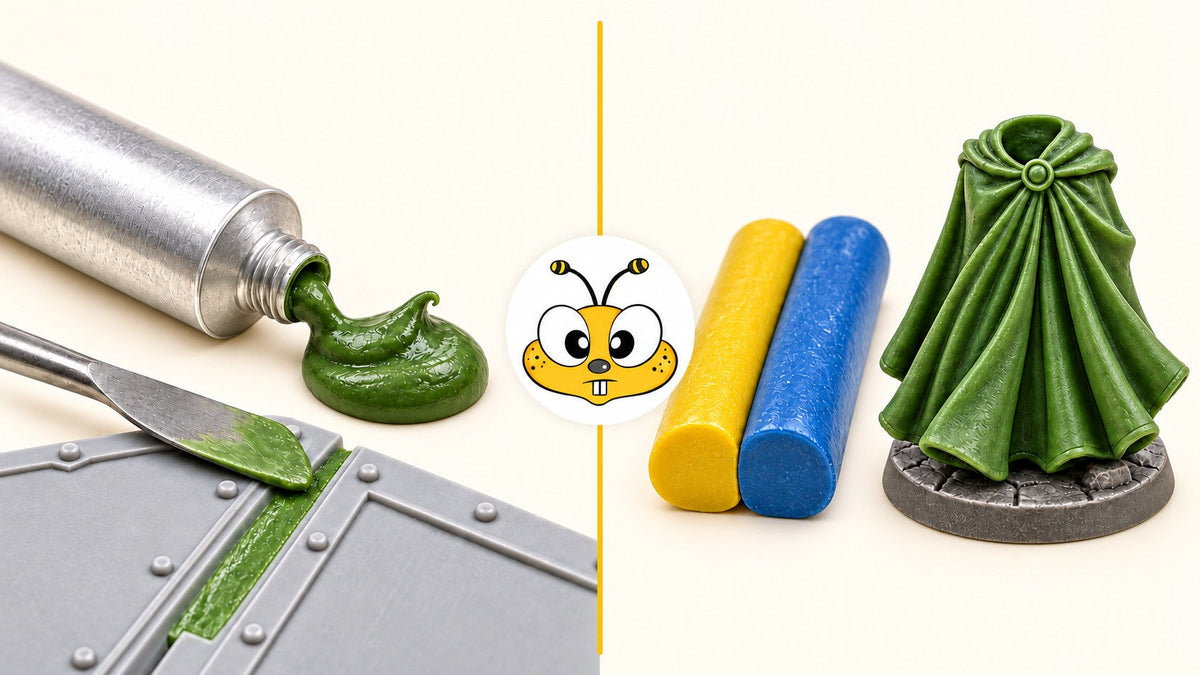

No—AK Modeling Green Putty is not the same as Green Stuff sculpting epoxy. AK Green Putty is a one-component, water-based polyurethane filler. The Army Painter’s Green Stuff is a two-part epoxy mixed before use. The similar names describe different materials, so choose by the repair you want to make, not by the color.

The difference to check before buying
| Check | AK Green Putty | Green Stuff |
|---|---|---|
| Material | One-component, water-based polyurethane | Two-part epoxy |
| Preparation | No second component to mix | Mix the yellow and blue parts |
| Starting point | Surface filling | Sculpting, conversions and gap filling |
Which matches your model-building job?
You want to fill a visible seam
For a surface gap between already assembled model parts, AK Green Putty is a filler worth considering. Apply it with a spatula or similar tool to a clean, dry, grease-free surface. It dries to a hard finish and allows water cleanup.
First decide whether you are hiding a surface defect or correcting poor alignment. Dry-fit the parts before reaching for filler. A seam caused by an incorrectly seated part deserves another look at the assembly; adding material does not fix the fit underneath.

You want to sculpt a cloak, pouch or conversion detail
Choose a material explicitly intended for sculpting. The Army Painter’s Green Stuff is a sculpting and conversion epoxy. Knead equal portions of the yellow and blue components until uniformly green. That is a different workflow from spreading a single-component filler.
A useful shopping question is: “Am I making a new shape, or making an existing surface continuous?” A miniature’s new cloak points toward a sculpting material; a small surface blemish points toward a filler. Green Stuff can also fill gaps when a conversion needs both shaping and repair.
You need to close a gap and add a new shape
Green Stuff’s uses include gap filling as well as sculpting. A conversion can involve both jobs, so do not assume you must buy two materials simply because one says “filler.” Write down the actual task before buying: smoothing a join and building a raised detail ask different things of the material.
Do the drying and handling instructions transfer?
No. Use the directions for the exact product in your hand. Allow the filler to dry before continuing with surface preparation. An epoxy tutorial’s working or curing time does not apply to a single-component filler.
For Green Stuff, follow the package’s mixing, working and curing instructions. The Army Painter specifies protective gloves. Read each product’s handling precautions before starting; color is not a guide to chemistry or safe handling.
Before you add a filler to your basket
- Choose the right material. A tutorial calling for Green Stuff needs sculpting epoxy, not simply any green-colored putty.
- Describe the job. Identify whether you need surface repair, a sculpted addition or both.
- Plan the next stage. Finish the repair according to the material’s directions before moving on to surface preparation and paint.
If your task calls for the single-component filler described here, see AK Modeling Green Putty for current availability. For the later primer-selection step, our Mr. Surfacer grade guide explains how those surface-preparation options differ.