Home & Kitchen / Guides & How-To’s
How Much Soil for a 4×8 Raised Bed? Bags for Filling or Topping Up
Filling an empty bed or topping up an old one? Find the soil volume, round up the right number of bags and compare delivered costs before you buy.
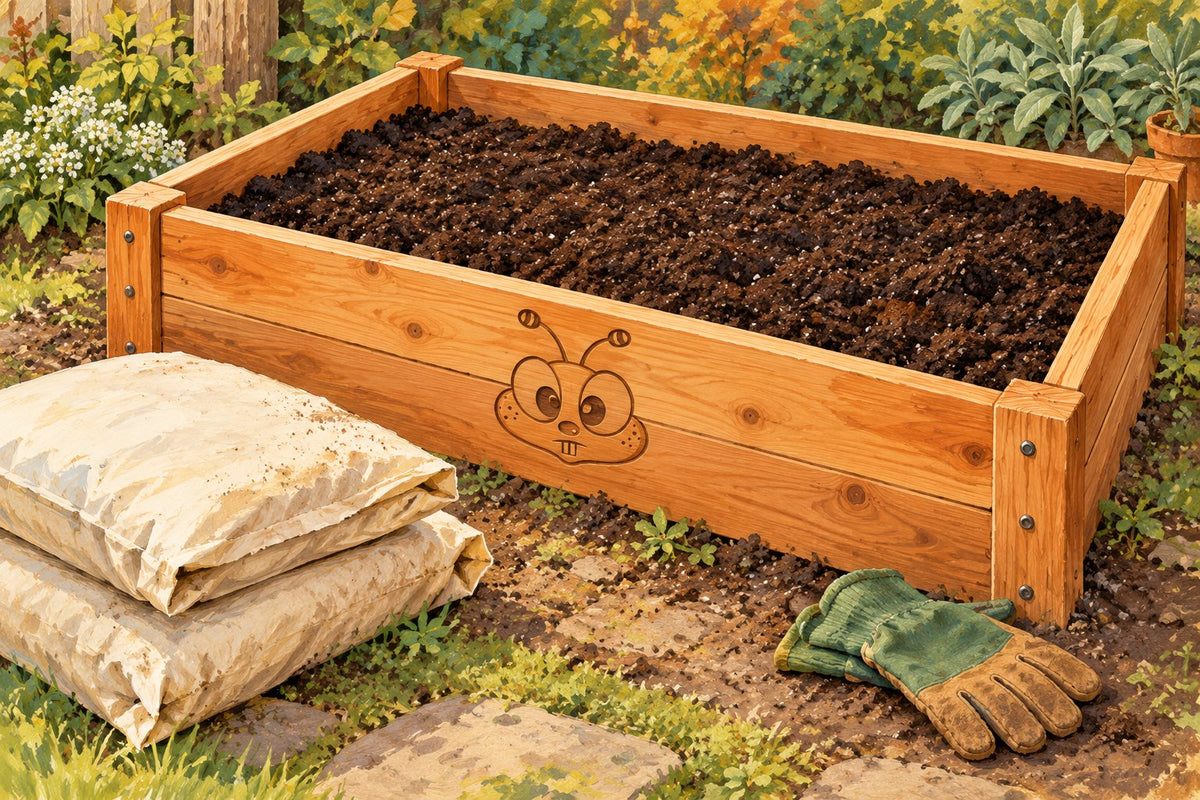
A raised bed with an inside footprint of 4 by 8 feet needs 32 cubic feet of soil for a 12-inch fill. That is 16 bags at 2 cubic feet each, or 22 bags at 1.5 cubic feet. Topping up an existing bed by just 2 inches needs about 5.33 cubic feet: three 2-cubic-foot bags.
It’s easy to picture the herbs and tomatoes. The pile of soil bags is usually the surprise. Before you order, separate two questions: how much space needs filling, and what material belongs in that space. The first is straightforward arithmetic. The second depends on your bed, existing soil and planting plans.
Use the charts below for a straight-sided, rectangular bed at ground level. A table-style planter, a bed with a false bottom or a curved metal bed needs its own usable dimensions or the maker’s stated capacity.
Measure the fill, not just the frame
Take the inside length and width. A bed sold as “4×8” may describe its outside footprint; thick walls and corner posts reduce the room available for soil.
Next, choose the intended soil level below the rim. Measure the vertical space from the bottom of the area being filled to that level. That’s your fill depth. Don’t automatically use the wall height, especially if you’re leaving space for mulch.
Starting with an empty bed?
Measure the whole depth you intend to fill with growing material.
Refreshing an existing bed?
Measure only the gap between the current soil surface and your intended new level.
If the surface is uneven, check several places across the bed and use an average gap for an estimate. Don’t count soil that’s already there as something you need to buy again.
Use one formula, then round the bags up
Length in feet × width in feet × added depth in inches ÷ 12 = cubic feet
Cubic feet ÷ volume per bag = bags needed. Round the final bag count up to a whole bag.
For a 4×8 bed and a 10-inch fill: 4 × 8 × 10 ÷ 12 = 26.67 cubic feet. Divide by a 2-cubic-foot bag and you get 13.33 bags, so buy 14. Keep the unrounded volume in your calculator until the final step.
Ordering in bulk? Divide cubic feet by 27 to get cubic yards. A 32-cubic-foot fill is about 1.19 cubic yards. Ask which increments the supplier sells; one cubic yard alone provides 27 cubic feet and leaves you 5 cubic feet short.
Working in centimeters? Length × width × depth ÷ 1,000 gives liters. For example, an inside space of 120 × 240 cm filled 25 cm deep holds 720 liters. Divide by the liters printed on the bag and round up.
4×8 raised-bed soil bag chart
These numbers assume an actual inside footprint of 4×8 feet. They describe the volume being added, not a recommended growing depth for every crop.
| Added depth | Cubic feet | 1.5 cu ft bags | 2 cu ft bags |
|---|---|---|---|
| 6 inches | 16 | 11 | 8 |
| 8 inches | 21.33 | 15 | 11 |
| 10 inches | 26.67 | 18 | 14 |
| 12 inches | 32 | 22 | 16 |
For several beds using the same material, add their unrounded volumes first, then divide by the bag size. Rounding separately for every bed can leave you buying more bags than the combined job needs.
Topping up? The shopping list gets much shorter
A shallow top-up spreads a modest quantity over a surprisingly large area. For the same 4×8-foot inside footprint:
| Top-up depth | Cubic feet | 1.5 cu ft bags | 2 cu ft bags |
|---|---|---|---|
| 1 inch | 2.67 | 2 | 2 |
| 2 inches | 5.33 | 4 | 3 |
| 3 inches | 8 | 6 | 4 |
The rounded bag total may exceed the exact volume. Three 2-cubic-foot bags provide 6 cubic feet, for example, but the 2-inch top-up needs about 5.33. Stop at your intended level rather than emptying the last bag just because it’s open.
A low surface doesn’t automatically call for a thick layer of compost. Choose what to add based on the existing growing mix and soil-test recommendations. Repeated heavy compost additions can build up nutrients and salts.
Choose the mix before comparing prices
For an ordinary ground-level raised bed, look for a suitable raised-bed blend or a locally recommended topsoil-and-compost mixture. Don’t assume straight compost, garden soil and potting mix are interchangeable. A planter on legs behaves differently from a bed open to the ground, so follow its filling and load instructions.
The chart measures volume. A bag marked only in pounds can’t be converted reliably to cubic feet without information about that particular material. Look for its stated volume or ask the supplier. If a compressed product lists an expanded yield, follow its preparation instructions and use the applicable yield.
For US gardeners, local extension advice helps match the mix and planting schedule to local conditions. October planning in a cold-winter area may be for next spring; a warmer region may still have a fall planting window. The quantity calculation stays the same, but the planting calendar doesn’t.

Compare the delivered total, not just the bag price
Price the same suitable mix in the quantities you actually need. Bags may be convenient for a small top-up; bulk material deserves a quote for a larger fill. Include delivery, minimum orders and how you’ll move it from the drop-off point to the bed.
An example with made-up prices
For a 32-cubic-foot fill, suppose 2-cubic-foot bags cost $8 each: 16 × $8 = $128 before tax.
Suppose a comparable bulk mix costs $60 per cubic yard, the supplier sells quarter-yard increments, and delivery is $65. Ordering 1.25 cubic yards costs $75 + $65 = $140 before tax and supplies 33.75 cubic feet.
In that example, bags cost less despite the bulk mix’s lower unit price. Use your local quotes; these are arithmetic examples, not current store prices.
Allow for settling without guessing a universal percentage
New raised-bed material can settle, and organic ingredients lose volume as they decompose. That doesn’t give every mix the same predictable shrinkage rate. The charts give the starting geometric volume, not a promise that the surface will stay at that height.
Follow the mix supplier’s guidance for filling and settling, then measure the remaining gap. A follow-up top-up calculation is more useful than automatically buying an extra 20 or 30 percent for every bed.
Before placing the order, note four things: the inside dimensions, the actual depth to add, the bag’s volume and the total delivered cost. Once those agree, you can spend less time counting bags and more time deciding what you’d like to grow.
Keep exploring small projects and practical ideas in The Daily Find.