Home & Kitchen / Guides & How-To’s
How Much Wrapping Paper Do You Need for a Box?
Measure once, wrap with less guesswork. Find a starting sheet size, compare roll widths and plan how many gift boxes your paper can cover.
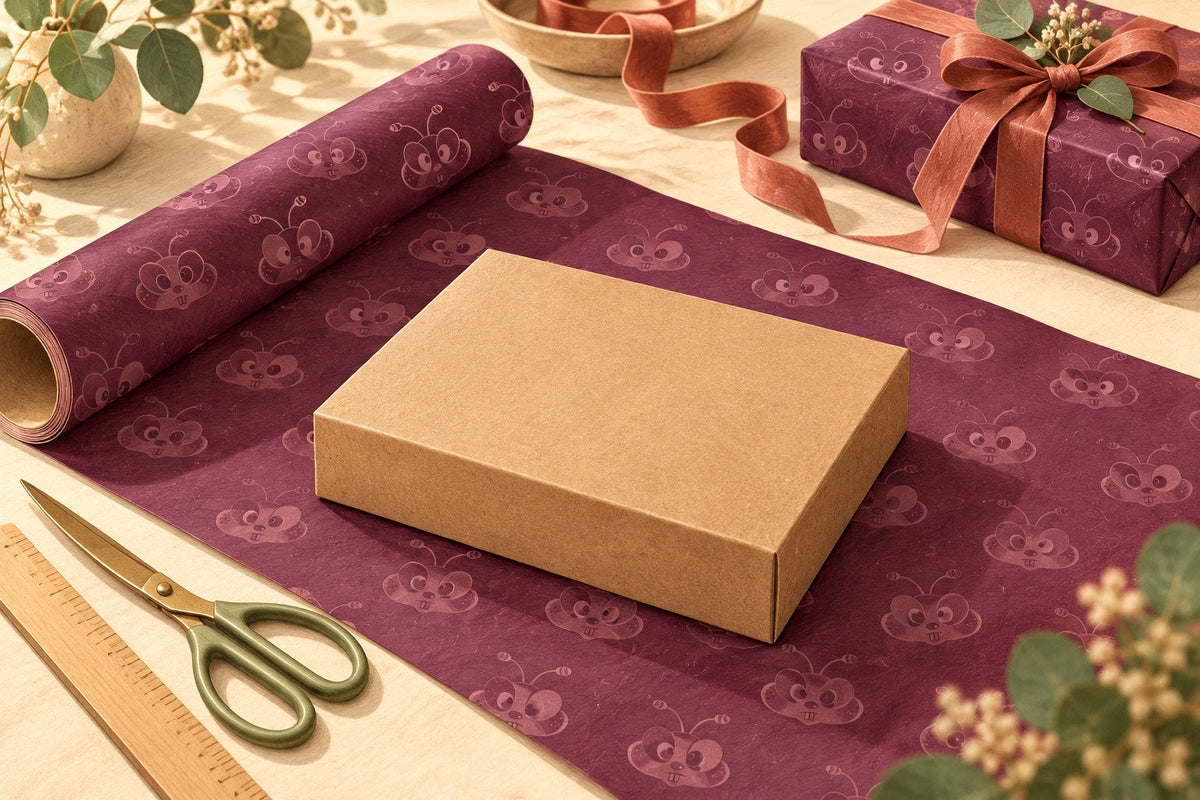
For a 12 × 8 × 3-inch rectangular box, a 24 × 16-inch sheet is a useful starting size for a conventional wrap. It includes a 2-inch overlap around the box and 2 inches of paper beyond each end. Check the folds against the actual box before cutting your favorite paper.
A roll can look generous and still leave you one frustrating strip short. The trick is to plan a rectangle of paper first, then see how that rectangle fits across the roll. The square-foot number on the label comes later.
01 / Start with the box
Measure the outside, with the lid on
Set a firm rectangular box on its broad face. Call its long edge L, its shorter edge W, and its height H. Measure the closed box, including any projecting lid. Keep all three measurements in the same unit.
For the example, L is 12 inches, W is 8 inches and H is 3 inches. These letters describe the box; they do not have to match the way a wrapping-paper seller uses “length” and “width.”
Pack the gift before measuring. A lid that bulges changes the shape you need to cover. If a gift needs to stay upright, keep that orientation and test the paper in place rather than turning it over for a neater seam.
02 / Two directions, two jobs
How to calculate a starting sheet size
One direction goes around the four sides of the box. The other runs along its length and leaves paper for the two folded ends. The plan below uses a 2-inch seam overlap and an end allowance of two-thirds of the box height at each end.
Round each result up to the next whole inch if it is fractional. This is a practical cutting plan for ordinary flexible gift paper, not a claim that it is the smallest possible sheet. Thick paper, a rolled-under edge or a decorative fold may need a different allowance.
Your 12 × 8 × 3-inch box
A = 2 × (8 + 3) + 2 = 24 inches
B = 12 + (4 × 3 ÷ 3) = 16 inches
Start with a 24 × 16-inch rectangle. The 3-inch height gives a 2-inch allowance at each end: ⅔ × 3 = 2.
A few box sizes to compare
| Box L × W × H | Sheet A × B |
|---|---|
| 10 × 7 × 2 | 20 × 13 |
| 12 × 8 × 3 | 24 × 16 |
| 14 × 10 × 4 | 30 × 20 |
| 16 × 12 × 6 | 38 × 24 |
Do not choose a row just because the box looks like a shoebox or shirt box. Those names do not specify dimensions. For centimeters, use the same geometry with your chosen seam allowance in centimeters; do not add 2 centimeters when you mean 2 inches.
03 / Shop by dimensions
Will the sheet fit your wrapping-paper roll?
Compare both sides of your planned sheet with the usable roll width. If either side fits across, the other becomes the length you cut from the roll. Try the two orientations on paper before deciding which uses less roll length.
These examples use the same 24 × 16-inch sheet. The wider roll uses less length per box, but that alone does not prove it costs less or wastes less paper. Compare the purchase price, usable leftovers and the other gifts you need to wrap.
Why square footage is not enough
A hypothetical roll measuring 30 inches wide by 8 feet long contains 20 square feet: 2.5 × 8 = 20. At 16 inches of roll length per box, its 96-inch length allows six of our example sheets in a single-column layout. That leaves no extra length for mistakes or damaged ends.
A 15-inch-wide roll can also contain 20 square feet if it is 16 feet long. But neither the 16-inch nor the 24-inch side of this planned sheet fits across it. Equal area does not mean equal usefulness for this box. A different wrapping method or a joined sheet would be a separate plan.
For a straightforward batch of identical boxes, divide the usable roll length by the length needed for one sheet and round down. Add room for a practice wrap or damaged paper before buying. Mixed box sizes need a layout: a narrow leftover may fit a small gift, but it cannot be counted as another full-size sheet.
Check directional prints before rotating the sheet. A design with words, figures or trees may face the wrong way. Matching motifs across a seam can also consume extra paper. A plain or non-directional pattern gives you more freedom to turn the cutting rectangle.

04 / Before the scissors
Do one loose fit check
Lay the box on the reverse of the paper and bring the wrap around it without fastening it. Check the long seam, then center the box and check both end folds. The paper should close without pulling hard or leaving a gap. Only then mark the cut.
If you have several matching boxes, finish one wrap first. Keep its successful sheet measurements with the remaining boxes, and use a paper template if that makes marking easier. Recheck any box with a different lid or depth.
Children can choose colors or decorate tags; match cutting tools to their ability and provide adult supervision. Keep loose blades and sharp scissors away from younger children.
05 / Rescue the paper you have
When a sheet is too short or too bulky
The long seam leaves a gap
Check that you used the dimension intended to go around the box. If the rectangle can be turned and still cover both ends, try that before cutting again. Otherwise, a contrasting paper band over the gap can make the join deliberate. Check that the whole gift is covered before taping.
The ends have too much paper
Center the box first. Excess on only one end may be a placement problem. With the box centered, rehearse the end folds and mark what can be trimmed. Avoid removing paper from both ends based only on how one folded corner looks.
The roll is too narrow
Compare both orientations of your sheet. If neither fits, join compatible sheets, choose a wider sheet or use a gift bag that fits. A diagonal wrap is a different layout; rotating a box does not guarantee that any undersized sheet will work.
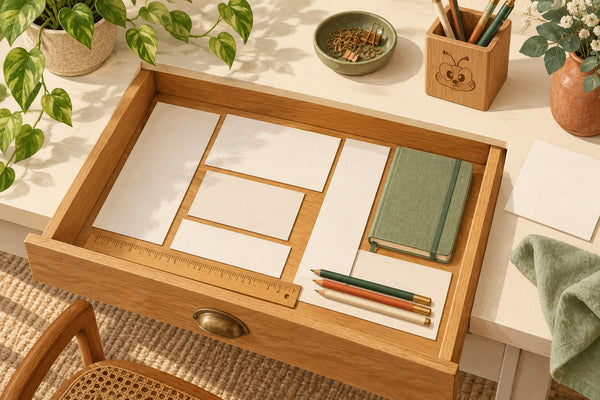
Keep useful offcuts flat and group them by size. A slim strip can become a paper band or tag, while a larger rectangle may suit the next small box. For storing tape, scissors and tags, a measured drawer layout can help you use the space you already have.
The best preparation is a small note: box dimensions, successful sheet size, roll width and cut length. Next time, you can start with the ribbon instead of wondering whether the paper will reach.