Hobbies & Collectibles / Guides & How-To’s
Yarn Substitution: How Many Balls Do You Need?
Found a yarn you love, but the balls are a different size? Turn the pattern’s yardage into a clear shopping list, with worked examples for colors and yarn held double.
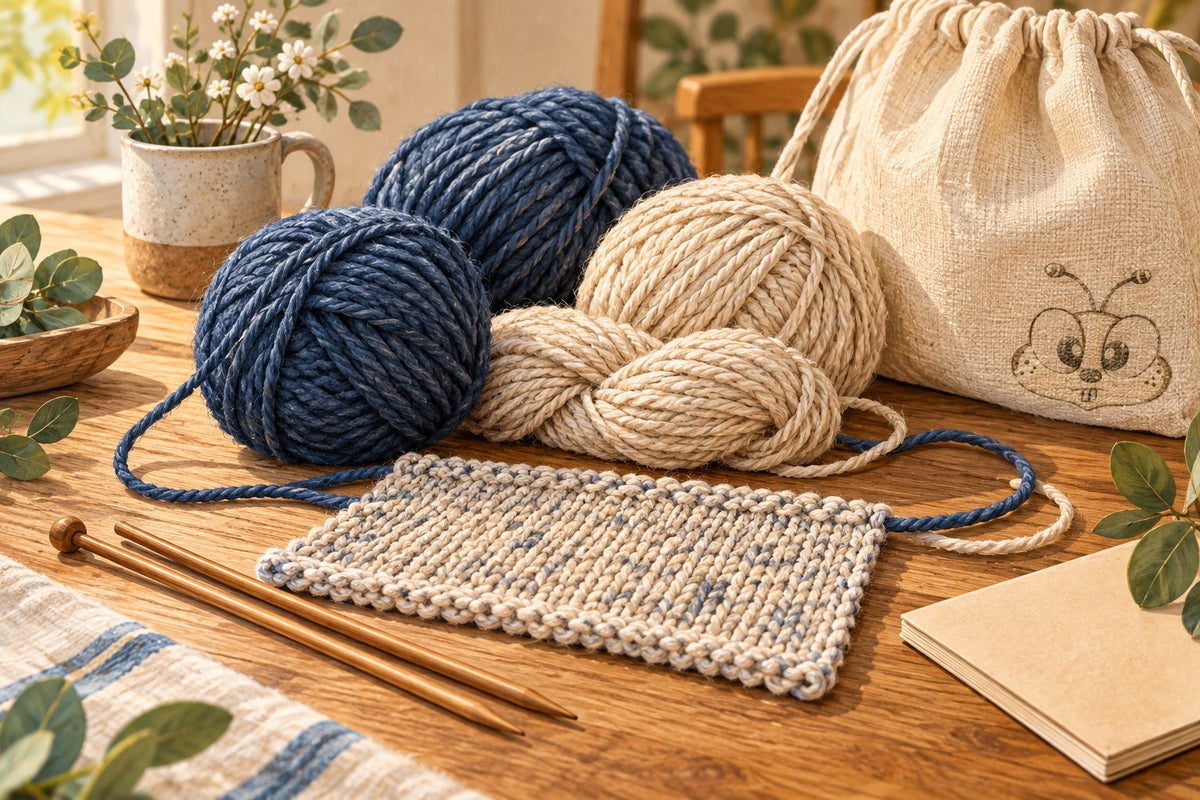
To calculate how many balls of substitute yarn to buy, divide the length your pattern needs by the length in one replacement ball, then round up. A project needing 900 meters requires eight 125-meter balls: 900 ÷ 125 = 7.2. First check that the replacement yarn can produce the pattern’s gauge and the kind of fabric you want.
The lovely color is the easy part. The confusing part is standing between a pattern that says “six balls” and a shelf of balls in different sizes. Turn both into meters or yards, and the shopping decision becomes much clearer.
01 / Match the fabric first
Same yarn weight does not mean the same result
“DK” or “worsted” describes a thickness category. “50 g” describes the mass of the ball. Neither tells you how much knitting it contains. Two balls can weigh the same and hold different lengths; two yarns in the same thickness category can also produce different fabrics.
Start with the pattern’s gauge, fiber and yarn construction. A smooth yarn and a fluffy yarn can show the same stitches very differently. Check care instructions too: a gift intended for ordinary machine washing needs a suitable yarn and finished-item care plan.
Make a swatch in the pattern’s specified stitch and working method. Wash and finish it as you intend to treat the project, following the yarn’s care directions, then let it dry before measuring. Check both stitch and row gauge and whether you like the fabric’s drape. Changing needle size can help with gauge, but an unpleasantly stiff or loose swatch is a reason to reconsider the yarn.
A small gauge difference can change the size
Imagine a straight section with 100 stitches. At 20 stitches per 4 inches, it measures 20 inches across. At 22 stitches per 4 inches, the same 100 stitches measure about 18.2 inches. That is almost 1.8 inches narrower, before considering any shaping.
Buying more yarn will not fix that sizing difference. Settle the fabric and gauge before relying on a quantity estimate.
02 / Translate balls into length
Calculate the replacement ball count
- Find the amount for your exact size. Use the pattern’s stated total meters or yards if it supplies them. If it only lists balls, multiply the original ball count by the original length per ball.
- Read the replacement label. Find the length per ball for the exact yarn and color you plan to buy. Keep both sides of the calculation in the same unit.
- Divide and round up. A fractional answer means another whole ball is needed. Check what allowance remains after rounding.
Round up to a whole number of balls.
Worked example: six original balls become eight
Suppose your size calls for six balls of a yarn with 150 meters in each ball. That gives a planning total of 6 × 150 = 900 meters. The replacement contains 125 meters per ball, so 900 ÷ 125 = 7.2. Round up to eight balls.
Buying six replacement balls just because the pattern says six would give you only 750 meters—150 meters below the original shopping total. Buying seven would still leave a 25-meter shortfall.
| Length per ball | Buy | Total / spare |
|---|---|---|
| 100 m | 9 balls | 900 m / 0 m |
| 125 m | 8 balls | 1,000 m / 100 m |
| 150 m | 6 balls | 900 m / 0 m |
| 200 m | 5 balls | 1,000 m / 100 m |
The table compares quantities, not interchangeable yarns. More meters in a ball does not make it a better substitute. And when a pattern lists full balls rather than actual usage, their combined length is a shopping estimate, not a measurement of what the designer knitted into the sample.

03 / Keep colors separate
Calculate each color on its own
Spare cream yarn cannot finish a blue sleeve. For a pattern with several colors, keep a separate length target and ball count for each one.
For example, 600 meters of a main color and 180 meters of a contrast color, both supplied in 125-meter balls, need five main-color balls and two contrast-color balls. Those provide 625 and 250 meters respectively.
Combining the requirements gives 780 meters, and rounding 780 ÷ 125 up happens to give seven balls too. But that total alone does not tell you which seven to buy. Six main-color balls and one contrast ball would leave the contrast color 55 meters short.
04 / Two strands, separate supplies
What if the pattern uses yarn held double?
When two strands travel through every stitch together, each strand needs its own supply. Read the materials list carefully: a pattern may already give the required amount for each yarn or the combined amount of one yarn held double. Do not automatically double a total that already includes both strands.
A pattern specifies 500 meters of each yarn
Strand A
500 m ÷ 125 m per ball
4 balls
Strand B
500 m ÷ 210 m per ball
3 balls
The supplies provide 500 m of A and 630 m of B. The extra B cannot replace a shortage of A.
If the pattern explicitly requires 500 meters per strand and both strands will use the same replacement yarn, plan for 1,000 meters of that yarn in total. At 125 meters per ball, that is eight balls. You still need to arrange two working ends.
Replacing two different yarns with one thicker yarn is a different substitution. The combined texture, gauge and fabric change; adding the two original yardages does not tell you how much of the thicker yarn the project will consume. Look for a designer-supplied alternative or work out the new fabric and requirements before committing to the full purchase.
05 / Leave room to finish
How much extra yarn should you buy?
Check the pattern’s allowance and your plans before adding a percentage. Swatches, longer sleeves, extra repeats and other changes can all affect the amount. There is no single extra-ball rule that fits every project.
In the 900-meter example, eight 125-meter balls already provide 100 meters above the target. As an illustration, a chosen 10% allowance would make the target 990 meters, so eight balls would still cover it. A chosen 15% allowance would make it 1,035 meters, requiring nine. Those percentages demonstrate rounding; they are not universal recommendations.
Compare the dye-lot identifiers within each color when the yarn uses them. Keep the labels with your project notes so you can identify the yarn later. If buying extra depends on returning an unused ball, check the seller’s conditions before purchasing or winding it.
My pattern gives grams, but no length
Find the original yarn’s label information. If it contains 150 meters per 50 grams and your size calls for 300 grams, the original requirement converts to 900 meters. Use that length to plan a suitable replacement. If you cannot identify the original yarn or its length, grams alone are not enough for a dependable conversion.
My swatch matches stitches but not rows
Check how the pattern controls length and shaping. Instructions worked for a measured length differ from instructions with a fixed row count. A different row gauge can affect armholes, increases and other shaped areas. Resolve that with the pattern’s guidance before assuming the substitution is settled.
I am between two ball counts
Round up, then multiply the result by the length per ball to see your actual supply. Compare that with the target and any separately planned allowance. Rounding 7.2 down to seven is still a shortage, even if seven looks close.
Write down the yarn, color, dye lot, length per ball, quantity and swatch measurements together. The next time you open the project bag, you will know why those balls belong to that pattern—and be ready to enjoy the knitting.